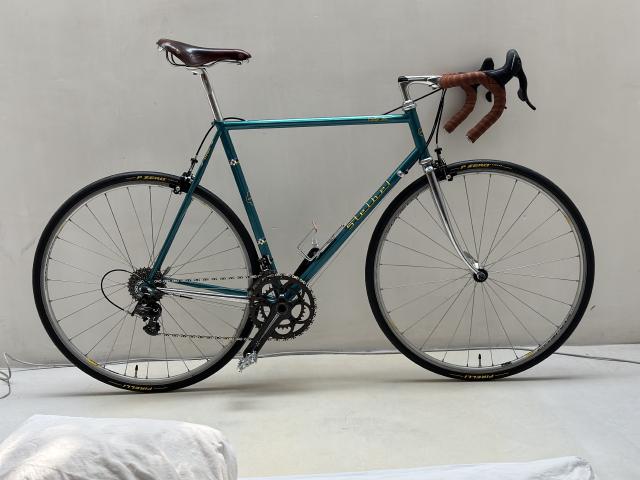
A Brooks saddle, fresh from the box, is notoriously uncomfortable. The leather is stiff, unbending, almost hostile to the rider. This is by design — a fact that separates Brooks from every other saddle manufacturer and explains why cyclists either become devout believers or sceptical outsiders. There is no middle ground with Brooks. The commitment is total, or it’s nothing.
Most of my collection rides on Brooks. Not by accident, but because their philosophy aligns with the bikes they’re mounted on: built for the long term, improving with use, asking the rider to invest in the relationship.
160 Years of Sitting Down
John Boultbee Brooks founded his saddle manufactory in Birmingham in 1866 — the same Birmingham that would later produce Reynolds tubing and countless other cycling innovations. The early designs featured the characteristic arched profile and tensioned leather construction that remains recognisable today. By the 1880s, Brooks saddles were the choice for serious British cyclists, and the brand’s leather craftsmanship had become a byword for quality.
The B17, introduced in 1935, became a design icon that endures unchanged to this day. Its distinctive shape — twin leaf springs beneath the leather, a refined nose geometry, a width that accommodates the majority of human sitting bones — proved ergonomically superior for both road and touring cyclists. Throughout the mid-twentieth century, the B17 appeared beneath the greatest cyclists of the era, from Fausto Coppi to the riders of the Tour de France. Professional racing teams selected Brooks not for sponsorship but for proven performance. The brand’s reputation for comfort on multi-hour rides became legendary.
In 2002, the Italian conglomerate Selle Royal acquired Brooks, ensuring survival while maintaining manufacturing traditions. Rather than diluting identity, the acquisition accelerated innovation. The Cambium range, launched in 2012, introduced vulcanised rubber stretched over a nylon base — a contemporary material solution that preserves the leather saddle’s aesthetic and comfort philosophy while eliminating break-in time and weather concerns. It was a radical departure from 146 years of leather tradition, and it worked.
The Break-In Contract
The first twenty miles on a new Brooks are a negotiation. The saddle is unyielding. There’s genuine discomfort, occasionally genuine suffering. At mile thirty, you might question every decision that led to this moment. By mile fifty, something shifts. The leather, gradually warmed and pressured by your specific anatomy, begins to conform.
This process isn’t a bug — it’s the core philosophy. Brooks saddles mould themselves to the individual rider in ways that foam and gel never will. The leather, over hundreds of miles, develops a hammock-like support that distributes pressure across a wide area rather than concentrating it on two points. The result, once achieved, is a comfort that makes returning to a synthetic saddle feel like sitting on a park bench.
The Colnago Master, which I’ve ridden hundreds of miles, has a Brooks that now feels like an extension of the geometry. No other saddle would work on that bike because the Brooks isn’t just shaped correctly anymore — it’s shaped correctly for me. My sitting bones have found their specific indentations. The leather has learned my weight distribution, my pedalling style, my tendency to shift slightly right on steep climbs. This information is encoded physically in the material.
Brooks Across the Collection
The diversity of Brooks models across my bikes tells a story about how saddle choice relates to riding intention. The Stelbel Strada Oria carries a Brooks Swift — slender, racing-oriented, minimal. The Veloheld IconX Titan sits atop a Brooks B15 Swallow Titanium — a model that pairs titanium rails with the traditional leather top, saving weight while maintaining the core philosophy. The Look KG 361 and 795 Light both carry Brooks Cambium C15 saddles — the modern vulcanised rubber alternative, chosen because these are bikes that might sit in rain, might be ridden in any conditions, might not receive the careful post-ride attention that leather demands.
Each pairing feels inevitable once you ride them. The Swift’s narrow profile matches the Stelbel’s aggressive, race-oriented geometry. The B15 Swallow’s titanium rails complement the Veloheld’s titanium frame with an aesthetic and philosophical coherence. The Cambium’s weather indifference suits the Look bikes’ role as all-conditions machines.
The Mason Exposure carries a Brooks leather saddle — the classic, not the Cambium — because the Exposure is a touring and adventure bike, and nothing says “I will be riding this for eight hours through uncertain weather” quite like a broken-in Brooks leather saddle atop a steel frame. The saddle will outlast the tyres, the cables, the brake pads, the chain, the cassette, and possibly the frame itself.
The Leather Equation
Genuine leather demands maintenance. A neglected Brooks will crack, deteriorate, eventually fail. This is presented sometimes as a disadvantage — and if you’re looking for a component that requires no thought, it absolutely is. But consider the alternative: a synthetic saddle that never improves, never ages gracefully, never becomes more comfortable or more personal.
The leather on my oldest Brooks saddles has darkened with age and use. There are subtle creases where sitting bones naturally rest. Water marks show where rain has soaked the leather on a ride through an unexpected downpour. These aren’t defects — they’re evidence of relationship. The saddle has learned my body the way a favourite jacket learns its wearer.
Brooks understood this from their founding. The leather they use is vegetable-tanned, a slower and more expensive process than chrome tanning, but one that produces a material with superior ageing characteristics. Vegetable-tanned leather develops a patina; chrome-tanned leather merely deteriorates. The distinction is fundamental to the Brooks philosophy: they’re not selling you a saddle, they’re selling you the first chapter of a decades-long story.
The Cambium: Tradition Rethought
The Cambium range deserves its own consideration because it represents something rare: a heritage brand successfully innovating without betraying its identity. The vulcanised natural rubber top, stretched over a nylon frame, mimics the hammock-like flex of broken-in leather without the break-in period. It’s waterproof. It’s maintenance-free. It’s available tomorrow, fully ready, no suffering required.
Some purists dismiss the Cambium as a concession to convenience. I think that’s ungenerous. The Cambium solves a genuine problem — not everyone has the patience or riding volume for a proper leather break-in — while maintaining the essential Brooks experience: a saddle that flexes naturally with the rider’s movement rather than compressing like foam.
On my Look 795 Light, the Cambium C15 is the right choice. The bike is technical, demanding, and often ridden in conditions where a leather saddle would need immediate attention afterwards. The Cambium asks nothing except to be ridden. And it rewards that riding with a comfort that, while different from broken-in leather, is genuine and immediate.
The Mathematics of Longevity
Brooks saddles cost more than mass-produced alternatives. A B17 runs approximately CHF 100-130. A Swallow Titanium considerably more. These aren’t impulse purchases.
But do the mathematics. A quality Brooks leather saddle, maintained with occasional applications of Proofide leather dressing, can reasonably last ten to fifteen years of regular riding — some last far longer. The cost-per-mile calculation becomes compelling when compared to synthetic saddles that lose their shape and cushioning after two or three seasons.
More importantly, the Brooks doesn’t just last — it improves. A three-year-old Brooks is better than a new one. A five-year-old Brooks is better still. This is the opposite of every other component on a bicycle, all of which begin degrading the moment they’re installed. The saddle is the one part of the bike that gets better with age.
The Maintenance Ritual
Caring for a Brooks is minimal but necessary. Occasional applications of Proofide — Brooks’s own leather conditioner — keep the hide supple and water-resistant. Tension adjustment via the nose bolt compensates for gradual leather stretch. Protection during storage, basic cleaning after wet rides.
These aren’t burdens — they’re rituals that create continuity between rider and machine. You remember to care for the saddle because it’s asked you to care, and in return it cares for you by becoming more comfortable over time. Compare this to the passive relationship with a synthetic saddle: use it, replace it, use another one identical to the first. There’s no history, no development, no sense that the component is adapting to your needs.
The Spiritual Element
I recognise this might sound romantic about an object meant for sitting, but there’s something real here. The leather saddle that has darkened and creased to match your body represents a compact between equipment and user. The saddle promises longevity and constant improvement. The rider promises maintenance and commitment. Neither party can abandon the agreement without loss.
My oldest Brooks has probably fifty thousand miles of sitting behind it. The leather has an appearance of almost velvet. The creases are deep and deliberate. It’s neither new nor worn-out — it’s established. It’s seen roads and seasons and decades of conversation between cyclist and machine.
This is what John Boultbee Brooks understood from the beginning, in Birmingham, in 1866: that the most honest relationships between human and tool aren’t determined at the moment of purchase. They develop through time and attention. The patina isn’t decay — it’s evidence of a life well-lived.