When Campagnolo announced Ekar in 2021, there was a moment of collective silence in the cycling community. Not scepticism, exactly — more like confusion. A 13-speed groupset? From Campagnolo, the company that had spent seventy years refining the art of road cycling components? A single chainring, no front derailleur? What were they doing?
The answer, as I’ve come to understand through living with five Ekar-equipped bikes in my collection, is that they were asking a different question entirely. Not “how do we adapt our road groupset for gravel?” but “what would a gravel groupset look like if we designed it from first principles?”
Thirteen Speeds and the Logic Behind Them
The number thirteen is deliberate. In road cycling, where the difference between gears is measured in fractions of a tooth and cadence optimisation matters over hours of sustained effort, twelve speeds made sense as an evolution from eleven. But gravel riding presents a fundamentally different gearing problem.
You need a massive low gear for pushing up loose, technical climbs — potentially loaded with bikepacking bags. You need tight spacing in the middle of the cassette where you spend most of your time on rolling terrain. And you need enough top-end to keep up on tarmac connections between gravel sections. Twelve speeds with a single chainring couldn’t achieve all three without unacceptable gaps somewhere in the range. Thirteen could.
The cassette runs 9-42 teeth — a 467% range that covers everything from spinning up 15% gravel pitches to cruising at 40 km/h on flat roads. The progression between gears is calibrated so that no single shift feels like a jarring jump. This is pure Campagnolo: mathematical precision applied to a practical problem, solved with one more sprocket than anyone else thought necessary.
Five Bikes, One Groupset
My collection has become, somewhat accidentally, an extended test laboratory for Ekar. Five bikes run the groupset across different frame materials and riding intentions:
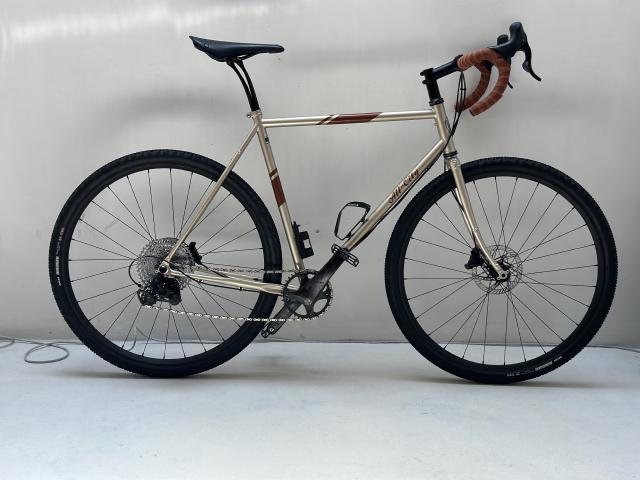
The All City Space Horse in Champagne Shimmer was my introduction to Ekar. This 612 Select CroMoly steel touring frame — double-butted main tubes with tapered, ovalised and dimpled chainstays — is designed for loaded stability. The Ekar groupset transforms it from a touring bike into something more versatile: the 13-speed range means I don’t need a front derailleur even when climbing Swiss passes with panniers. Deda Gravel Power handlebars provide the flared drops that gravel demands, and at 11.15 kilograms the complete bike is honest about what it is — a comfortable, capable machine for long days.
The Veloheld IconX Titan pairs Ekar with TiAl3V2.5 titanium — Grade 9, an alloy that combines aluminium and vanadium for extraordinary vibration damping. The 40-tooth chainring with a 9-42 cassette provides range that would have required a double crankset five years ago. On gravel, where the Veloheld spends most of its time, the Ekar’s mechanical shifting is impervious to the mud, dust, and standing water that would give electronic systems pause.
The Standert Erdgeschoss — Berlin-designed, stainless steel, in the extraordinary Rawkim colourway that leaves half the frame raw and half painted — runs Ekar with Zipp Service Course SL XPLR carbon bars and a Columbus Cross+ carbon fork. At 10 kilograms, it’s the most refined of my Ekar bikes, and the combination of stainless steel’s corrosion resistance with Ekar’s mechanical reliability creates something genuinely maintenance-free. Chris King Inset 7 headset, sliding dropouts, clearance for 650b x 54mm tyres. It’s a bikepacking machine that looks like a sculpture.
The Genesis Volare 931 Disc proves that Ekar works on a road-geometry frame. Reynolds 931 stainless steel — the finest steel tubing available — paired with a gravel groupset seems contradictory on paper. In practice, the Ekar’s range covers everything from steep Swiss climbs to fast Rhine valley flats, while the 931 frame handles each scenario with composed efficiency. Mavic Ksyrium UST Disc wheels with tubeless tyres complete a build that refuses to be categorised.
And the Open U.P. Rapha Limited Edition — the original performance gravel bike, designed by former BMC engineer Andy Kessler to prove that one frame could race on tarmac, gravel, and singletrack — is the frameset in the collection that most deserves Ekar, though it currently awaits its final build. The U.P.’s road geometry with mountain-bike tyre clearance defined the modern gravel category before gravel bikes existed. Ekar, with its road-cycling precision adapted for off-road reality, is the logical groupset for a frame that similarly refused to choose between disciplines.
Mechanical by Choice
What strikes me most about Ekar is that Campagnolo resisted the urge to add electronic shifting. This was not a cost-cutting decision — Campagnolo has electronic shifting expertise in their road groupsets. It was a philosophical one.
On a gravel ride, you’re dealing with mud, water crossings, dust, extended periods without access to power outlets, and the occasional crash that sends you sliding across loose surfaces. Electronic derailleurs demand battery management, charging protocols, firmware awareness. A dead battery at kilometre eighty of a hundred-kilometre gravel route isn’t a minor inconvenience — it’s a ride-ending problem.
Ekar stayed mechanical, indexed, and straightforward. The shifting is precise — not with the feathery lightness of electronic systems, but with the satisfying mechanical certainty that Campagnolo has refined since the 1950s. The Ergopower levers have a distinct click-and-engage feel. Each shift is a deliberate action with tactile confirmation. Over thousands of kilometres across five bikes, I’ve never had an Ekar shift fail. Never had a ghost shift. Never had a moment where the derailleur didn’t do exactly what was asked of it.
The Build Quality
Ekar components, held in hand, feel like Campagnolo. This matters more than it might seem. The derailleur cage is longer than Record’s, designed for the massive cassette range, but it carries the same surface finish, the same precision in the pivot bearings, the same sense that every millimetre was considered. The brake callipers — hydraulic, flat-mount — offer the kind of modulation that road cyclists expect from Campagnolo. Progressive, controlled, with enough power to stop a loaded gravel bike on a steep descent.
The crankset is perhaps the most elegant component: a single chainring — 38, 40, or 42 teeth depending on your gearing preference — with a dedicated spider that’s lighter and stiffer than adapted double-ring designs. There’s no compromise of a road crankset with one ring removed. This was designed as a single-ring system from the start.
The cassette itself deserves attention. Thirteen sprockets on a single freehub body required Campagnolo to develop the N3W freehub standard — a new interface designed specifically for the additional cog. The spacing is calculated so that each shift across the 9-42 range feels proportionally consistent: the jumps between smaller sprockets are tight enough for cadence-sensitive riding on smooth terrain, while the larger sprockets are spaced more generously where exact cadence matters less than having the right ratio for a steep, loose climb. It’s the kind of mathematical optimisation that only matters when you’re eighty kilometres into a ride and every unnecessary effort compounds.
The Disc Brake Advantage
Ekar was Campagnolo’s first groupset designed exclusively for disc brakes — hydraulic, flat-mount, with the same lever feel that road cyclists expect from the Vicenza workshop. On gravel, where conditions change from dry dust to standing water within a single ride, hydraulic discs offer consistent modulation regardless of rim condition. The centrelock rotors at 160mm provide stopping power calibrated for loaded bikes descending technical terrain at speed.
The lever design itself is worth noting. Campagnolo’s Ergopower mechanism uses separate thumb and finger paddles — a fundamentally different approach from the single-lever designs of competitors. On gravel, where hands spend more time on the hoods and bar tops than in the drops, this separation means shifting is available from multiple hand positions without the awkward reach that some rival systems demand. It’s a small ergonomic detail that reveals itself over hours, not minutes.
A Different Kind of Excellence
Campagnolo’s reputation is built on decades of refinement applied to racing. Ekar suggests they understand that excellence means something different on gravel. It’s not about shaving seconds on a climb. It’s about reliability in variable conditions. It’s about ratios that make sense for exploration rather than pure speed. It’s about a groupset that works when everything around it is trying to make it stop working.
Some in the industry viewed Ekar as Campagnolo chasing the gravel trend. I see it differently. Ekar represents Campagnolo acknowledging that roads aren’t the only story worth telling anymore. The groupset isn’t a cheapened version of Record — it’s a genuine rethinking of what components should be for riders exploring beyond the tarmac.
In that sense, Ekar might be the most Campagnolo thing Campagnolo has done in decades: taking fundamental engineering principles — mechanical precision, thoughtful ratio progression, build quality that assumes the components will be used hard for years — and applying them faithfully to new terrain.
The Open U.P. frameset, still waiting for its build in my workshop, embodies this same philosophy of refusal to compromise. Designed in Basel by former BMC engineer Andy Kessler, the U.P. — “Unlimited Possibilities” — was built to race on tarmac, gravel, and singletrack from a single platform. Its BB386EVO bottom bracket, Smartmount disc brake system, and clearance for mountain bike tyres up to 2.1 inches make it perhaps the most versatile frame ever designed. At 1,040 grams for the frame alone, it’s lighter than most carbon road frames. When I finally build it with Ekar, it will be the meeting of two ideas that share the same conviction: that choosing between road and off-road is a false choice, and that engineering excellence doesn’t have to mean engineering narrowness.
Tullio Campagnolo invented the quick-release because he couldn’t get his wheel off in the cold on a mountain pass. Ekar exists because the mountain passes aren’t always paved.