There’s something quietly magnificent about holding a Record component from 1995 and comparing it to one from 2020. Both are unmistakably Campagnolo — that particular shade of anodized aluminum, the mechanical precision that feels almost delicate — yet the span of innovation between them is staggering. Tullio Campagnolo founded his company in Vicenza in 1933, a city already renowned for metalworking, and the philosophy he embedded there has proven remarkably durable: mechanical precision as a kind of faith, each component an argument that engineering excellence needs no embellishment.
The Record groupset has been Campagnolo’s flagship for decades, the choice of racers and perfectionists alike. In my collection, I have the privilege of tracking this evolution across four bikes and three distinct generations — from 9-speed to 11-speed to 12-speed — each representing a moment in cycling’s long pursuit of efficiency and elegance. What strikes me most is not how much has changed, but how much of the original character has survived.
The Nine-Speed Era: Mechanical Perfection on the Colnago Master
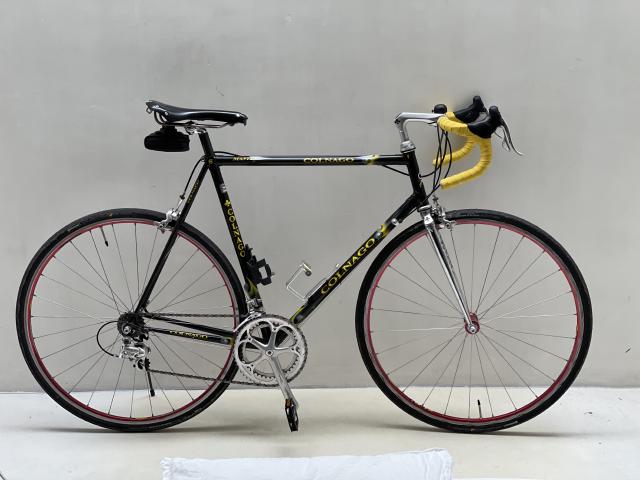
The 1996 Colnago Master in my collection carries a 9-speed Record groupset, and it is perhaps the most purely mechanical expression of Campagnolo’s art. The Master itself is a fitting host — built with Columbus steel tubing in that timeless black-and-gold livery, the star-shaped tube cross-sections providing torsional rigidity while preserving the legendary suppleness that made these frames the choice of champions. At 9.6 kilograms complete, it is not light by modern standards, but every gram feels purposeful.
The 9-speed Record setup pairs a standard 53/39 crankset with Ergopower levers — Campagnolo’s thumb-and-finger shifting mechanism that was, at the time, a revelation in ergonomic design. Nine speeds meant a narrower cassette, a shorter-throw derailleur, and fewer compromises in chain-line geometry. The chainrings were forged, not stamped. The derailleur cage had that distinctive Campagnolo curve, its shape refined through decades of iteration in the Vicenza workshops. The whole system communicated directly: cable tension translated into movement with minimal intermediation, and you could feel the mechanical logic of it through your fingertips.
This was the era before electronics whispered their way into cycling. Campagnolo’s control over the professional peloton in the 1990s was near-absolute — using non-Campagnolo equipment at the Tour de France was considered eccentric. The Super Record groupset of 1974 had established the template, and by the time my Master’s 9-speed Record was manufactured, the engineering had been refined to a state of quiet perfection. There is no index click that feels quite like a 9-speed Record shifting under load — a sensation both precise and organic, as though the mechanism is breathing with the rider.
The Eleven-Speed Transition: The C40 and the Stelbel
Moving forward a generation, two bikes in my collection carry 11-speed Record: the Colnago C40 Team Olympus and the Stelbel Strada with its Oria star-shaped tubing. They represent the same groupset on radically different platforms, and the contrast is instructive.
The C40 is Colnago’s first full-carbon frame — arguably the most successful race bike of the 1990s. My example is a first-generation model from 1996 or 1997, wearing the Team Olympus livery in black, blue, and white. Carbon-fibre tubes bonded into lugs gave a stiffer, lighter chassis than anything else in the peloton at the time, launching the carbon era that now dominates professional racing. At 7.7 kilograms for frame and fork alone, it was a revelation. Paired with 11-speed Record — the compact 50/34 crankset, Ultra-Shift Ergopower levers, dual-pivot brake calipers — the C40 feels like a machine built for one purpose: going fast with absolute precision.
The Stelbel Strada is a different animal entirely. Built around 1989 by Stelio Belletti, who was among the first in Italy to use TIG welding for bicycle frames (he patented the technique in 1975), the Strada uses Oria’s distinctive star-shaped tubing — a radical departure from the round tubes of the era. Oria, based in Bergamo, produced some of the most inventive steel tubing of the 1980s; their star-shaped cross-section increased torsional rigidity and aerodynamic efficiency while keeping weight low. The Polish national team won gold at the 1975 Mettet world championships on Stelbel bikes, and Belletti produced roughly a thousand frames total between the early 1970s and 1990. Mine wears a stunning teal with gold decals, and at 9.3 kilograms it rides with a suppleness that carbon cannot replicate.
Both bikes share the same 11-speed Record groupset — the same Ultra-Shift Ergopower levers clicking through the same predetermined positions, the same dual-pivot calipers providing stopping power. Yet the experience is profoundly different. On the C40, the shifting feels surgical, each click arriving with clinical efficiency against the rigid carbon chassis. On the Stelbel, the same shift has a warmth to it, the steel frame absorbing and softening the mechanical event. It is a reminder that a groupset does not exist in isolation — it is part of a conversation between frame, rider, and road.
The jump from 9-speed to 11-speed required tighter tolerances and more precise engineering. Campagnolo had to achieve reliable indexing across two additional sprocket positions, which meant rethinking spring loads, cable pull ratios, and the geometry of the derailleur parallelogram. The result was a system that shifted faster and offered a wider range of gearing options, yet retained that unmistakable Campagnolo feel — the slight resistance before the click, the positive engagement, the sense that every movement is deliberate.
The Twelve-Speed Present: The Nevi Grimsel
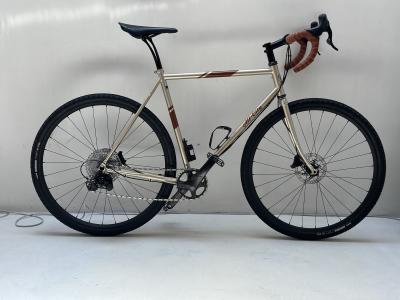
The Nevi Grimsel represents the current frontier of mechanical Record. This titanium frame, handbuilt in Bergamo by an artisan workshop that has been producing frames since 1992, carries the full 12-speed Record groupset — and it is a machine that bridges tradition and modernity with uncommon grace.
The Grimsel’s frame is Grade 9 titanium (3AL-2.5V), cold-drawn tubing that delivers a supple, fatigue-resistant ride. At 1,370 grams for the frame alone, it is lighter than any steel in my collection, yet it possesses a ride quality that is uniquely its own — neither the sharp responsiveness of carbon nor the warm flex of steel, but something in between, a kind of effortless resilience. The brushed titanium finish needs no paint; it is honest in a way that appeals to anyone who values materials for what they are rather than what they pretend to be.
Onto this frame, the 12-speed Record groupset feels entirely at home. The Ultra Torque crankset in 50/34 compact, the Record rear derailleur handling a Super Record 11-32 cassette, the Record titanium brake calipers — every component speaks the same language of precision that Tullio Campagnolo established nearly a century ago. Twelve individual cogs demand twelve different mechanical positions, twelve different engagement points on the derailleur. The tolerances are tighter than ever. The cassette spans a range — 11 to 32 teeth — that would have seemed impossible to a 9-speed engineer. Yet the shifting remains unmistakably Record: that same deliberate click, that same sense of mechanical intention.
What the Grimsel reveals most clearly is how Campagnolo has managed to scale complexity without sacrificing character. The 12-speed system is objectively more sophisticated than the 9-speed on the Master, yet it does not feel more complicated. It feels like the same idea, refined. The engineering has evolved, but the philosophy — that mechanical precision is sufficient, that a well-designed system needs no electronic assistance — remains intact.
A Matter of Perspective
Some might argue that the jump from nine to twelve speeds is progress — and in terms of gearing range and shifting performance, it undoubtedly is. The 11-32 cassette on the Grimsel offers climbing ratios that the Master’s 9-speed setup cannot approach. Others might suggest that each generation has surrendered some small measure of mechanical purity for the sake of incremental gains. The chain is narrower, the tolerances less forgiving, the system more dependent on precise setup.
I find truth in both views. What I value most is the thread of continuity. Campagnolo introduced the quick-release hub in 1930 because Tullio couldn’t remove a wheel with frozen fingers during a race — a practical solution born of frustration. Nearly a century later, the Record groupset still embodies that same principle: solve the problem elegantly, with mechanical means, and trust the rider to appreciate the result.
In an era of electronic shifting and wireless control, Campagnolo maintains that properly engineered mechanical systems offer real advantages — lighter weight, independence from batteries, tactile feedback that connects rider to machine. Whether that position is principled or stubborn depends on your perspective. But holding a 9-speed Record lever in one hand and a 12-speed in the other, feeling the family resemblance across decades of evolution, I am inclined toward admiration.
The bikes in my collection are not museum pieces — they are evidence of a manufacturer that has managed perhaps the rarest trick in cycling: innovation without betrayal of founding principles. From the Columbus steel of the Master to the carbon of the C40 to the titanium of the Grimsel, the frames have changed utterly. The Record groupset, across all its generations, has remained itself.