There is a line that runs through Italian cycling like a seam in leather — visible if you look, invisible if you don’t. It connects Ernesto Colnago’s first frames in 1954 to Stelio Belletti’s TIG-welded revolution in 1973 to Sergio Finazzi’s titanium obsession in 1992. Three builders, three philosophies, three materials, one shared conviction: that a bicycle frame is not merely an engineering solution but an expression of its maker’s understanding of what cycling should feel like.
My collection contains frames from all three. Riding them in sequence is like reading three chapters of the same story, each written in a different dialect of the same language.
Colnago: The Dynasty
Ernesto Colnago founded his company in Cambiago, near Milan, in 1954. He was thirteen when he was apprenticed to Gloria Bicycles, a serious racing cyclist until a crash ended his competitive career, and then — in the way of people who cannot be separated from their obsessions — he began building frames instead.
The details of Colnago’s early innovations are well documented: the cold-bending technique for fork tubes in 1956, the star-shaped Columbus tubing that would become the Master’s signature, the transition from steel to carbon that produced the C40. What’s less documented is the philosophy that drove these innovations. Colnago believed that a bicycle should engage all the senses of the rider — not just provide efficient power transfer, but look, feel, and respond in ways that create an emotional connection.
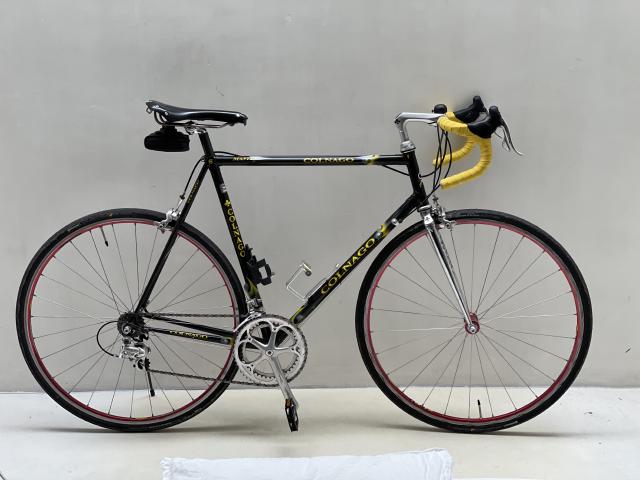
My Colnago Master embodies this philosophy in steel. The star-shaped Columbus tubes — stiffer laterally, more compliant vertically — give the frame a ride character that round-tube steel cannot replicate. The lugged construction is not merely structural; it’s aesthetic. Each lug is a finished piece of metalwork, filed and shaped to a standard that serves no engineering purpose beyond beauty. The teal-and-gold colour scheme is classic Colnago — bold enough to announce itself, refined enough to age well.
The Master carries a Campagnolo Record 9-speed groupset — the mechanical era, friction-based on the bars, requiring the rider’s sensitivity and skill. There’s no indexed click, no artificial guidance. You learn the geometry of your drivetrain through your fingertips. The complete bike, at approximately 9 kilograms, is a time capsule of early-1990s Italian racing: Columbus tubing, Campagnolo mechanicals, and the confidence that craft is a sufficient answer to any engineering question.
My Colnago C40, by contrast, represents the moment Colnago embraced carbon fibre. The C40 was revolutionary — a carbon-and-aluminium frame that proved carbon could be both competitive and durable in professional racing. Mine carries Campagnolo Record 11-speed, the indexed era, with Ultra-Shift Ergopower levers and dual-pivot brake callipers. Where the Master asks you to learn its language, the C40 speaks yours. The shifting is immediate, the frame response is direct, the carbon tubes transmit power with an efficiency that steel approximates but doesn’t match.
Together, the Master and C40 bracket Colnago’s transition from steel artisan to carbon pioneer. Both are unmistakably Colnago — that particular combination of Italian aesthetics and engineering ambition — but they represent fundamentally different approaches to the same problem.
Stelbel: The Innovator’s Workshop
Stelio Belletti came to framebuilding from aerospace. His family workshop in Italy serviced civil and military aeronautics, and the TIG welding techniques he mastered there were, in 1973, unknown in bicycle manufacturing. The established Italian builders — Colnago, De Rosa, Masi — used brazing and lugged construction, techniques refined over decades but fundamentally limited in precision and joint strength.
Belletti patented TIG welding for bicycle frames and became the first builder in Italy to own and operate a TIG welding machine. The results were immediately evident: cleaner joints, stronger welds, and a manufacturing precision that brazing couldn’t match. The Polish national cycling team won gold at the 1975 UCI World Road Championships in Mettet riding Stelbel frames. It was the kind of validation that transforms a workshop experiment into an industrial revolution.
My Stelbel Strada Oria dates from approximately 1989 — near the end of Belletti’s original production run, before the workshop closed in 1990 after producing roughly 1,000 frames total. The frame uses Oria’s signature star-shaped tubing, developed in Bergamo, which increased torsional rigidity and aerodynamic efficiency through a radical departure from the round tubes that every other builder was using. The aerodynamic bottom bracket shell is another Belletti innovation — form following function with the confidence of an engineer who understood both.
In stunning teal with gold decals, the Stelbel carries a Campagnolo Record 11-speed groupset, a 3ttt Ergo Podium handlebar and stem, Mavic Cosmos wheels, and a Brooks Swift saddle. At 9.3 kilograms, it’s not the lightest frame in the collection, but it might be the most historically significant. Stelbel frames are rare — roughly 1,000 total, and the Strada model with crimped Oria star-shaped tubing from 1986-1989 is a particularly sought-after variant.
Belletti’s story has a coda: in 2013, the Stelbel brand was revived through a collaboration between Cicli Corsa and Belletti himself. The new Stelbel continues the tradition of bespoke steel and titanium frames, blending original techniques with contemporary design. The tradition didn’t die; it paused.
Nevi: The Titanium Specialist
Sergio Finazzi founded Nevi in 1992, the same year he retired from professional cycling. The name itself carries poetic significance: “Nevi” is Italian for “snow,” inspired by a memorable stage of the 1988 Giro d’Italia that crossed the snow-covered Gavia Pass — an experience that crystallised Finazzi’s vision.
Where Colnago built an empire across materials and Belletti pioneered a technique, Finazzi made a different choice: he would master one material absolutely. Titanium. Every Nevi frame is processed exclusively using TIG welding — the same technique Belletti brought from aerospace two decades earlier — but applied to a material that demands even greater precision. Titanium is unforgiving of contamination during welding; atmospheric exposure during the process can compromise the metal’s integrity. Each Nevi frame is therefore welded in controlled conditions by craftspeople who understand the material at a molecular level.
My Nevi Grimsel is a titanium creation that carries the full weight and promise of modern Campagnolo: Record 12-speed, with its razor-tight tolerances across twelve individual cog positions. The frame is remarkably light for titanium, lighter than several of my steel bikes. But more than lightness, the Grimsel rides with a particular responsiveness that comes from titanium’s specific stiffness-to-weight ratio combined with Nevi’s careful engineering.
The Grimsel is named after the Grimselpass — one of the great Swiss mountain passes, and an appropriate namesake for a bike built in Bergamo that lives in Switzerland. Nevi’s innovation extends beyond pure titanium: they’ve developed the Titanio Legno line, combining titanium with walnut wood for frames that are simultaneously structurally sophisticated and visually extraordinary. It’s the kind of creative ambition that marks Nevi as a builder willing to push boundaries.
The Shared Language
What connects these three builders across decades and materials is harder to articulate than their differences. It’s not simply “Italian craftsmanship” — that phrase has been diluted by marketing until it means very little. It’s something more specific: a belief that the relationship between maker and material produces something that transcends the sum of components.
Colnago’s lugs are filed by hand not because machine-filed lugs wouldn’t work, but because the hand understands the form in ways that a machine cannot. Belletti brought aerospace welding to cycling not because it was easier, but because he understood that precision at the molecular level produces frames that respond to the rider at the sensory level. Finazzi chose titanium not because it was fashionable, but because he believed — as a former professional cyclist — that the material produced a riding experience that other materials couldn’t match.
These are not interchangeable philosophies applied to different materials. They are expressions of individual conviction — three men who each understood something specific about what a bicycle could be, and devoted their working lives to proving it.
The Collection’s Testimony
Riding the Colnago Master, the Stelbel Strada Oria, and the Nevi Grimsel on the same afternoon is to experience Italian framebuilding as a living tradition rather than a historical artefact. The Master’s lugged steel sings with a particular resonance. The Stelbel’s star-shaped tubes respond with an efficiency that feels decades ahead of its 1989 birthdate. The Grimsel’s titanium absorbs the road with a sophistication that steel can approach but not quite equal.
Three builders. Three decades. Three materials. One tradition — still very much alive, still producing frames that justify the investment of time, attention, and money that they demand. The line that connects Ernesto Colnago’s first workshop in Cambiago to Nevi’s titanium studio in Bergamo is unbroken. It runs through every frame in my collection that carries an Italian name.