In 1973, while the Italian workshops of Colnago, De Rosa, and Masi were refining techniques that had served them for decades — brazing steel tubes into lugged joints, filing each connection by hand — a chemical engineering student at MIT was asking a different question entirely. Gary Klein wanted to know what would happen if you abandoned steel’s comfortable traditions and built a bicycle frame from oversized aluminium tubes instead.
The cycling establishment’s answer was swift and dismissive: aluminium was too harsh, too stiff, too crude. It had no soul. It wasn’t steel. The Europeans had been building frames from Columbus and Reynolds tubing for generations, and they saw no reason to entertain the experiments of an American graduate student working out of a converted prune barn in California.
They were wrong.
The MIT Experiment
During MIT’s Independent Activities Period in January 1973, Klein and a group of fellow students, working under Professor Buckley, built an aluminium-framed bicycle. The results were immediately provocative. The frame was lighter than comparable steel frames and noticeably stiffer — power transfer from pedal to wheel was more direct, with less energy lost to frame flex. The ride was undeniably harsh compared to the best Italian steel, but Klein understood that harshness was a solvable engineering problem, while stiffness and weight were fundamental advantages.
After graduating in 1974, Klein relocated to some disused buildings on his parents’ farm in San Martin — structures that had previously been used for dehydrating prunes. The prune barn became the unlikely birthplace of a revolution. In 1977, he patented the use of large-diameter aluminium alloy tubes to increase frame stiffness, a concept that would eventually reshape the entire bicycle industry.
By 1980, Klein had moved to Chehalis, Washington, beginning production from a barn in nearby Mary’s Corner. The company grew steadily from modest workshop to a 70,000-square-foot factory, building frames that challenged everything the cycling world thought it knew about materials and design.
The Oversized Philosophy
Klein’s insight was elegantly simple: a tube’s resistance to bending increases with the cube of its diameter. Double the diameter of a tube, and you get eight times the stiffness for a given wall thickness. This meant that large-diameter, thin-walled aluminium tubes could be simultaneously lighter and stiffer than the narrow, thick-walled steel tubes that defined European framebuilding.
The visual impact was immediate and unmistakable. Where Italian steel frames were slender and traditional — tubes barely wider than a human thumb — Klein frames were bold, muscular, almost aggressive in their proportions. The oversized down tube, the massive head tube junction, the swept chainstays — these weren’t aesthetic choices. They were engineering consequences of thinking about tube diameter differently than anyone had before.
And then there was the paint. Klein pioneered multi-colour gradient finishes that became iconic — names like “Backfire,” “Storm,” and “Dolomite” evoking the boldness of the brand. Each frame was essentially hand-painted, making every Klein a unique object. In an industry where most frames came in solid colours or simple two-tone schemes, Klein’s paint was a declaration of intent: this is not your grandfather’s bicycle.
The Quantum Race in the Collection
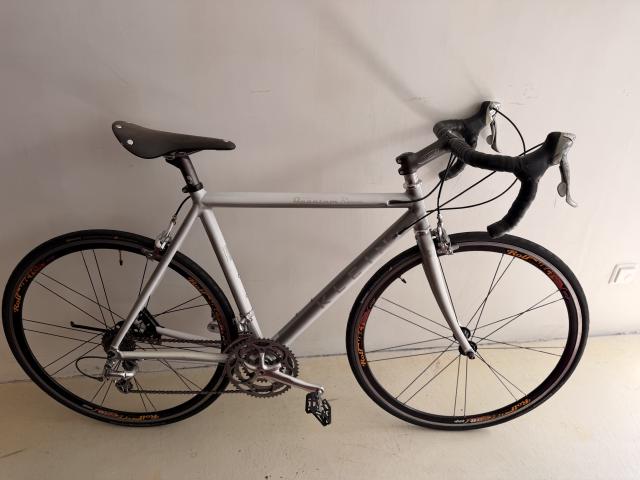
My Klein Quantum Race dates from the early 2000s — the final era of independent Klein production before the Chehalis factory closed in 2002, two years before Trek fully absorbed the brand. It’s a 53cm frame in a striking silver gradient finish, with TIG-welded construction and a carbon fork that provides a measure of front-end compliance that pure aluminium cannot offer.
The complete build weighs in at approximately 9 kilograms — competitive even today, remarkable for a turn-of-the-millennium aluminium frame. The Shimano Ultegra 9-speed groupset with a 39/53 crankset is a snapshot of its era: reliable, competent Japanese engineering paired with American frame innovation. STI Dual Control shifters provide indexed shifting that, while not as tactilely satisfying as Campagnolo’s Ergopower, is utterly dependable.
The supporting cast adds character: ICON Graphite handlebars, stem, and seatpost — period-correct carbon components that save weight at the contact points. Rolf Vector Comp wheels with their distinctive paired-spoke design — 18-hole front, 20-hole rear — were exotic when new and remain visually striking. Continental Grand Prix 4-Season tyres. And, in an anachronism I’m fond of, a Brooks Cambium saddle — the vulcanised rubber version, because a leather Brooks on an aluminium race frame from Washington State would be a cultural collision too far.
The Quantum Race rides exactly as you’d expect from its visual language: stiff, direct, immediate. Pedalling effort translates to forward motion with minimal waste. The frame doesn’t absorb road imperfections — it transmits them faithfully, sometimes aggressively. On smooth roads, this directness is exhilarating — the bike accelerates with a clarity that makes the Colnago Master feel languid by comparison. On rough surfaces, it’s educational. You learn which roads deserve the Klein and which deserve the Stelbel.
What surprises is how well the build has aged. The ICON Graphite cockpit components were cutting-edge carbon when new; they remain light, stiff, and visually coherent with the frame’s industrial aesthetic. The Rolf Vector Comp wheels, with their unconventional paired-spoke lacing pattern, reduced spoke count without sacrificing lateral stiffness — an engineering approach that mirrors Klein’s own philosophy of questioning received wisdom. And the Ultegra 9-speed groupset, humble by today’s standards, shifts with the unfussy precision that has always been Shimano’s greatest virtue. It lacks the tactile drama of Campagnolo, but it has never missed a shift in thousands of kilometres.
Aluminium’s Vindication
Gary Klein’s conviction that aluminium could outperform steel was vindicated not just by his own success but by the industry’s eventual capitulation. By the mid-1990s, every major bicycle manufacturer was producing aluminium frames with oversized tubing — the very design principle Klein had patented in 1977. Cannondale, Giant, Specialized, Trek — all adopted the oversized aluminium philosophy that Klein had pioneered from a converted prune dehydrator.
The irony is substantial. The European steel establishment that dismissed aluminium as soulless eventually embraced it as the default material for entry-level and mid-range bicycles. Aluminium frames today are manufactured by the millions in Taiwan, using the same fundamental tube geometry that Klein proved viable in his barn. The revolution succeeded so completely that it became invisible — the most effective kind of revolution.
The Collector’s Paradox
Klein ceased worldwide production in 2009, after Trek — which had acquired the company in 1995 — decided the brand no longer served their portfolio strategy. Pre-2002 models, built in the original Chehalis factory, are considered “true Kleins” by collectors and command premium prices. The paint alone justifies collecting — finding a Klein in good condition with an intact gradient finish is increasingly rare.
My Quantum Race sits in this collector’s territory: early 2000s, American-made, with the silver gradient intact. It’s not the most valuable Klein — the mountain bikes from the late 1980s and early 1990s hold that distinction — but it represents the final flowering of Gary Klein’s vision before corporate absorption smoothed away the brand’s distinctive edges.
There’s a particular melancholy in riding a brand that no longer exists. Every Klein on the road is a finite resource — no more will be made, and each year a few more succumb to crashes, corrosion, or simple neglect. The aluminium that Gary Klein championed doesn’t develop the romantic patina of steel; it doesn’t age gracefully. It either works or it doesn’t. This binary honesty is, in its way, the most fitting legacy of a man who believed engineering trumped tradition.
The Legacy
What Klein understood, and what the European establishment was slow to accept, is that tradition is not the same as truth. Steel was not the best material for bicycle frames — it was merely the most familiar. Aluminium’s advantages in stiffness and weight were real, measurable, and significant. The ride harshness that critics used to dismiss the material was an engineering challenge, not a fundamental flaw — one that carbon forks, seatpost design, and tyre technology have since largely solved.
Today, the bicycle industry has moved on to carbon fibre as the prestige material, and aluminium has become the workhorse of mid-range cycling. But every carbon frame with oversized tube profiles owes a conceptual debt to Gary Klein’s insight at MIT in 1973. The principle — that tube diameter matters more than wall thickness for frame stiffness — remains as true in carbon as it was in aluminium.
In my collection, the Klein Quantum Race serves as a reminder that innovation doesn’t always come from expected quarters. Sometimes it comes from a chemical engineering student in a prune barn, armed with a different question and the confidence to pursue it.