The story of Look begins with a broken leg on Alpe d’Huez in 1951 — not on a bicycle, but on skis. Jean Beyl, lying in a hospital bed in the French Alps, conceived a ski binding that would release before your bones did. It was the kind of pragmatic engineering insight that would define Look for the next seven decades: identify a mechanical problem, solve it with precision, then move on to the next impossible thing.
That the company eventually built some of the most consequential bicycle frames in history was, at the time, entirely unforeseeable.
The Clipless Revolution
By the early 1980s, Look had three decades of experience engineering release mechanisms for ski bindings — devices that must hold firm under enormous force, then release in an instant when the forces become dangerous. The parallels with cycling were obvious to anyone who’d ever watched a rider’s foot slip off a pedal in a sprint, or seen the consequences of toe clips that held too well in a crash.
In 1984, Look introduced the PP65 — the first clipless pedal system for road cycling. The concept was borrowed directly from ski-binding engineering: a spring-loaded mechanism that locked the shoe to the pedal through a cleat, allowing efficient power transfer while enabling emergency release through a lateral twist of the heel.
The validation came immediately and spectacularly. Bernard Tapie, Look’s owner, had acquired the La Vie Claire cycling team, and in 1985 Bernard Hinault — le Blaireau himself — won the Tour de France on Look PP65 pedals. Within a few years, toe clips and straps had become museum artefacts. Every modern clipless pedal system, from Shimano SPD to Crankbrothers, descends conceptually from that original Look design.
It’s the kind of paradigm shift that seems inevitable in retrospect. At the time, it was audacious.
Carbon’s First Frame
Look was not content to revolutionise how feet connected to pedals. In 1986, the company unveiled the KG86 — the first production carbon fibre bicycle frame. Built from a blend of carbon and Kevlar, the KG86 was immediately pressed into service at the Tour de France, where Greg LeMond and Bernard Hinault raced it through the mountains.
Carbon fibre in 1986 was exotic, expensive, and poorly understood by most of the cycling industry. The established framebuilders — the Italian workshops of Colnago, De Rosa, and Stelbel, the British steel merchants — viewed it with suspicion. Carbon was aerospace material. It had no tradition, no heritage, no soul. Or so the argument went.
Look’s response was to keep building carbon frames and keep winning races with them. The KG series evolved through the 1990s and 2000s, each generation refining the layup techniques, tube profiles, and manufacturing processes that would make carbon the dominant frame material in professional cycling.
Two Looks, Two Eras
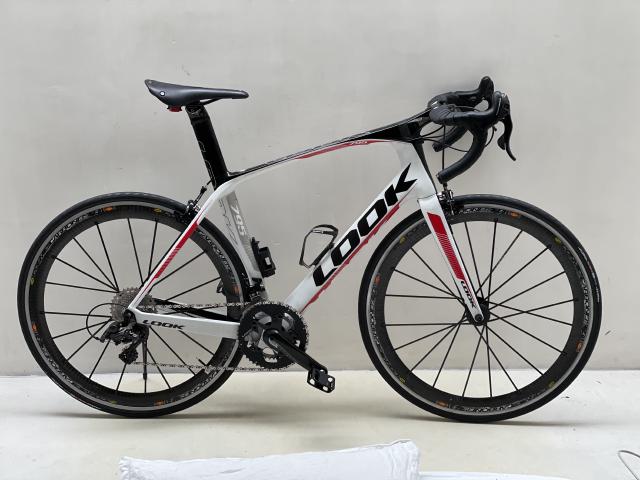
My collection contains two Look bicycles that bracket much of this evolution: the KG 361 and the 795 Light. They are separated by roughly fifteen years and an entire philosophy of frame design, yet both are unmistakably products of the same engineering culture.
The KG 361: Carbon HR and Quiet Competence
The KG 361 is a 2000s-era frame from Look’s mid-range, built with Carbon HR — High Resistance — tubes manufactured at Look’s factory in Nevers using a proprietary resin-transfer process. At 54cm with a complete build weight of 8.15 kilograms, it is not trying to be the lightest thing on the road. It is trying to be one of the most pleasant.
And it succeeds. The Carbon HR tubes absorb road vibration with a composure that steel approximates and aluminium rarely achieves. There’s a suppleness to the ride — not softness, but a considered absorption of the unnecessary. The frame does not chatter over rough surfaces. It simply moves through them.
Mine carries a Campagnolo Record 10-speed groupset with a compact 50/34 crankset — the mechanical era of Record, before electronic shifting became the expectation. The Ergopower levers have that distinctive Campagnolo shift action: a deliberate, mechanical engagement that rewards the rider who understands the geometry of cable tension.
The supporting cast tells its own story: a Deda Elementi Piega handlebar, a Look carbon stem, Mavic Ksyrium Pro Carbon SL UST wheels, and — an anachronism I’m particularly fond of — a Brooks Cambium saddle. The Cambium’s vulcanised rubber shell on a carbon frame from 2000s France is the kind of combination that would offend a purist. I find it perfect.
The KG 361 is not a collector’s piece in the way the 585, 595, or 795 models are. It is better described as an extremely competent bicycle that offers more ride quality per franc than most things with a Look badge. It represents the moment when Look’s carbon expertise had matured enough to produce excellent frames at scale — not just flagship models for professionals.
The 795 Light: Everything Integrated
The 795 Light, from 2015, is a different proposition entirely. Where the KG 361 is a frame that accepts standard components with grace, the 795 Light is a system — an integrated whole where frame, stem, seatpost, and crankset were designed together as a single engineering solution.
The carbon is 1.5k weave — meaning 1,500 filaments per carbon tow, compared to the common 3k or 12k weaves used by most manufacturers. Fewer filaments per tow means finer, more precise fibre placement and thinner laminate walls. This allows Look to sculpt tube profiles following NACA aerofoil certification — the same aerodynamic standards used in aviation. The result, in the hand, is a frame that feels implausibly light and eerily rigid.
At 2,300 grams for the frame in size S — with an uncut seat tube — the 795 Light was among the lightest aero-road frames of its era. The complete bike, with Campagnolo Super Record 12-speed and Mavic Cosmic wheels, weighs 7.6 kilograms. That is approximately the weight of a well-fed house cat.
The integration extends to nearly every contact point. The AeroStem is adjustable from -13° to +17° and comes in six lengths. The E-Post 2 seatpost houses an internal Di2 battery mount — a detail that reveals how deeply Look was thinking about electronic integration even in a mechanically shifted build. The ZED2 crankset is a carbon monobloc unit specific to the 795’s oversized 65mm bottom bracket shell.
This integration is simultaneously the 795 Light’s greatest strength and its most significant limitation. Everything works together with an elegance that discrete components cannot match. But when you want to change your stem length, or try a different crankset, or accommodate a seatpost from a different manufacturer, you discover that Look designed this bicycle for Look components. The buyer pool narrows accordingly.
My 795 Light runs the Super Record 12-speed groupset in its mechanical form, with an 11-34 cassette that provides range the nine-speed Record on the KG 361 could only dream of. The shift from ten speeds to twelve, from the KG 361’s era to the 795’s, represents not just two additional cogs but a complete reimagining of gear ratios, chain engineering, and derailleur geometry.
The French Difference
There is a philosophical thread connecting the ski binding, the clipless pedal, and the carbon frame. Each began as a solution to a specific mechanical problem. Each was validated through competition at the highest level. Each eventually became the standard by which competitors were measured.
Look’s approach to engineering is distinctly French in a way that’s difficult to articulate without resorting to cliché. It is not the precision-obsessed perfectionism of Campagnolo in Vicenza, nor the scale-driven refinement of Shimano in Osaka. It is something closer to what the French call ingéniosité — a cleverness that combines technical ambition with aesthetic sensibility.
The fact that Look still manufactures pedals in Nevers — still designs and develops in Burgundy, still maintains a factory where French technicians hand-lay carbon — matters. Not because French manufacturing is inherently superior, but because the continuity of knowledge, the accumulated craft intelligence of decades, produces results that cannot be replicated by outsourcing to the lowest bidder.
Between Two Centuries
Riding the KG 361 and the 795 Light back to back — which I have done, on the same route, on the same afternoon — is to experience the passage of time as a visceral, physical sensation. The KG 361 is warmer, more forgiving, more willing to be ridden casually. The 795 Light is taut, immediate, and faintly intolerant of anything less than full commitment.
Both are beautiful. Both are unmistakably Look. And both began, in some sense, with a broken leg on a ski slope in 1951 — a moment of pain that led to an insight about mechanical release, which led to clipless pedals, which led to carbon frames, which led to two bicycles in a Swiss collection that tell the story of how French engineering changed cycling forever.
Some lineages are worth tracing.