Ask a cyclist to name the great material debate and he will usually say steel versus carbon, as if the whole history of the bicycle were compressed into that one contemporary argument. I understand why. Carbon dominates the present tense. But in my own orbit the quieter and more revealing tension lies elsewhere, between steel and titanium. They are often presented as alternatives, as if one must cancel the other out, yet in practice they belong to a similar moral world. Both ask to be taken seriously. Both reward patience. Both still make sense when fashion has moved on.
I own more steel than titanium. That is partly habit, partly taste, partly the simple fact that steel has had more time to accumulate legends. But the one titanium bike in my collection has been enough to complicate any easy loyalty. After years of riding both, I no longer think in terms of winners. I think in terms of questions. What is this frame trying to do? What kind of road, weather, luggage, and rider does it imagine? What kind of builder stood at the bench, and what did he believe the bicycle should feel like when it was finally ridden into open air?
That matters more than the material alone.
Steel as a Deep Tradition
Steel has history on its side, but history is not the same thing as nostalgia. What keeps steel relevant is not merely that beautiful old bikes were made from it. It is that steel remains one of the most legible frame materials we have. Its behaviour is well understood. Its tubes can be selected, butted, shaped, and joined with enormous nuance. A builder can move from a classic lugged racing frame to a contemporary disc-brake adventure bike without abandoning the material’s essential intelligence.
Columbus, founded in Milan in 1919 by Angelo Luigi Colombo, sits at the centre of that long education. For more than a century they have supplied seamless tubing to many of the builders who defined how a road bike should ride. Entire schools of taste were built on Columbus tubesets. Colnago, De Rosa, Cinelli, and countless smaller names all depended on the simple truth that well-made steel tubing gave a framebuilder room to think. It allowed refinement through diameter, wall thickness, butting, geometry, and joining technique rather than through marketing language.
That is what I feel whenever I ride a good steel frame. Not sameness, because steel frames do not ride alike, but a kind of conversation with accumulated knowledge. The material does not decide the bike on its own. It leaves space for the builder to decide.
In my collection that breadth is obvious. One steel bike speaks with the accent of the late 1980s. Another belongs to an older Italian road tradition. Another is an entirely modern expression of steel, complete with internal routing, disc brakes, and tyre clearances that would have seemed almost comic on a racing frame thirty years ago. The continuity is material. The differences are intellectual.
The Stelbel and the Precision of Old Ambition
The steel bike that clarifies this best for me is the Stelbel Strada, a 56 cm frame from around 1989, painted in a deep teal or petrol blue with gold decals, the sort of colour combination that only an Italian racing frame can carry without sentimentality. It weighs 9.3 kg as built, runs a modern Campagnolo Record 11-speed group with a 50/34 compact crankset, dual-pivot rim brakes, a 3ttt Ergo Podium handlebar, a Brooks Swift saddle, and Mavic Cosmos wheels with 24 spokes at the front and 28 at the rear. On paper it is a period frame updated with practical modern parts. On the road it feels more interesting than that.
Stelbel matters because Stelio Belletti was not simply another artisan with a torch. Coming out of an aeronautical background, he became the first framebuilder to use TIG welding in bicycle construction, patenting the technique in 1975. The brand’s history carries a rare combination of workshop intimacy and genuine racing credibility: the Polish national team won the gold medal in the team time trial at the 1975 world championships in Mettet on Stelbel frames. That is not romance invented after the fact. It is proof that experimentation in the workshop had consequences on the road.
This particular Strada uses Oria’s star-shaped steel tubing, one of the more audacious ideas of the late steel era. Oria, based in Bergamo, was willing to treat tubing not as a fixed convention but as a site of invention. The star-shaped cross-sections were intended to increase torsional rigidity and offer a modest aerodynamic advantage while keeping weight low. Even now, decades later, the tubes look slightly improbable, as if somebody had managed to smuggle an idea from a wind tunnel into a handmade Italian road frame without disturbing its elegance.
And that is the point. Steel was never as conservative as lazy summaries make it sound. The Stelbel is not compelling because it is old. It is compelling because it reminds me that steel could be radical while remaining handmade, repairable, and deeply human in scale. The frame transmits effort with a firmness I associate with purposeful road bikes, yet it never loses the slightly tuned, resonant quality that makes steel feel alive under strain.
The Other Face of Steel
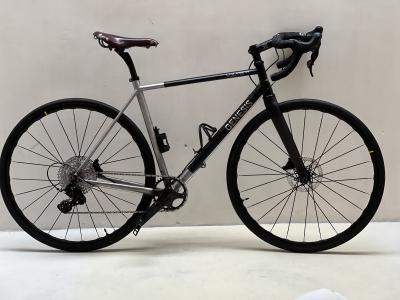
If the Stelbel is steel in a racing register, the Mason Exposure is steel written in a different key. It is a 2022 adventure frame, size large, built in collaboration with Cicli Barco in Italy and designed for the kind of riding that stretches days rather than sharpens minutes. The frame uses a progressively butted Dedacciai Zero Uno tubeset with Reynolds 631 in the rear triangle. It has full internal routing, a stainless T47 bottom bracket shell, a Mason RangeFinder AS carbon fork with 50 mm offset, and tyre clearance for 650B x 58 mm or 700c x 50 mm. Mine is built with a Shimano GRX 1x11 drivetrain and hydraulic flat-mount disc brakes in a 180/160 mm setup.
I find this bike helpful whenever somebody tries to reduce steel to a vintage mood board. The Exposure is thoroughly modern. It is engineered around bikepacking, long-range touring, and rough-surface confidence. The finish, DiffuserBlack Metallic with bronze hints, is contemporary without looking anonymous. The frame is dotted with useful details: rack mounts, multiple accessory cage mounts, sealed internal brake and dynamo routing, space for proper tyres and mudguards. Nothing about it is nostalgic. And yet it still offers the particular steel pleasure of being understandable. You can look at it and see what is doing the work.
That clarity matters to me. The Mason does not feel like the Stelbel at all. It is calmer, broader in its capabilities, less eager to turn every acceleration into an argument. But it shares steel’s talent for making the rider feel in conversation with the frame rather than merely carried by it. Over a rough track with luggage, that relationship becomes less romantic and more practical. A good steel adventure bike feels composed because the material and the design are cooperating rather than fighting.
Titanium and the Refusal to Rust
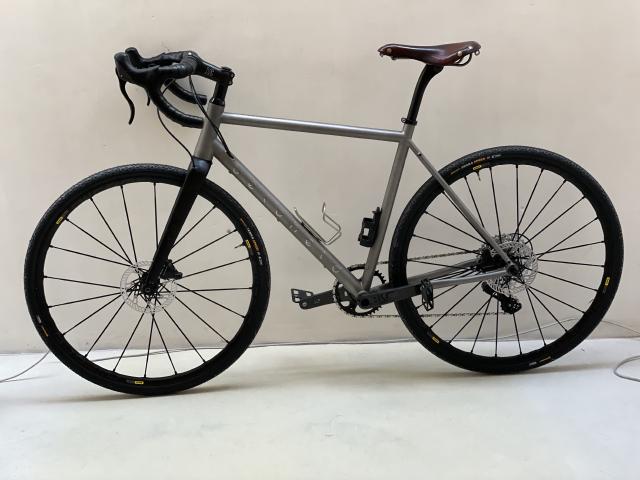
My titanium counterargument is the Veloheld IconX Titan, a 2021 gravel and all-road machine built in Germany by a small company with a workshop in Leipzig and roots in Dresden. Veloheld interests me for the same reason Stelbel does, though in a different national key: it is a builder with a clear idea of what in-house control and honest fabrication are worth. Since 2007 they have occupied a rare place in the contemporary market, producing steel and titanium frames close to home rather than outsourcing the heart of the bicycle.
The IconX uses TiAl3V2.5 titanium, also known as Grade 9, which adds small amounts of aluminium and vanadium to improve strength while keeping titanium’s natural corrosion resistance and vibration damping. The frame, in size M, weighs about 1.5 kg, paired with a 565 g carbon fork. It is Di2 ready, uses a tapered head tube, BSA 68 mm bottom bracket, Acros IS42/IS52 headset, and 27.2 mm seatpost, and allows tyre widths up to 50 mm. Mine runs Campagnolo’s Ekar 13-speed groupset with a 40-tooth chainring and a 9-42 cassette, a setup that makes perfect sense on a bike intended to leave tidy categories behind. The wheels are Campagnolo Shamal carbon, and the tyres are Schwalbe G-One R Pro Evo in 45-622.
On the road and on gravel, the IconX feels unmistakably different from the steel bikes. I am always suspicious when riders describe titanium in quasi-religious terms, as if the material possessed supernatural grace. But it would be equally silly to pretend that it feels the same. It does not. Titanium has a kind of poise under chatter and repeated impacts that I do not find in quite the same way elsewhere. Small irregularities disappear with less fuss. Washboard surfaces feel less argumentative. After a long ride over mixed terrain, I notice the difference not as a dramatic sensation during the ride but as reduced fatigue afterwards.
Then there is the matter of weather. A brushed titanium frame is almost scandalously indifferent to neglect. No paint to chip. No lacquer to cloud. No bubbling anxiety around a scratch that might become rust in another season. The IconX can be ridden through winter grit, wet spring lanes, and careless parking situations with a serenity that steel never fully permits. Steel asks for stewardship. Titanium often merely asks to be washed when one remembers.
What Numbers Clarify and What They Do Not
The usual comparison begins with density. Steel sits around 7.8 g/cm3, titanium around 4.5 g/cm3. This is true and not nearly sufficient. A bicycle frame is not a cube of raw material. It is a structure, and structures depend on tube diameter, wall thickness, junction design, intended use, and the builder’s appetite for risk. Titanium’s lower density allows larger-diameter tubes for a given weight, but those dimensions bring their own visual and mechanical consequences. Steel, denser and stiffer in other respects, can do more with smaller tubes and often with more delicate-looking proportions.
This is one reason a steel frame like the Stelbel can look almost impossibly fine while still feeling decisive under power. It is also why a titanium gravel bike such as the IconX can present itself with broader tubes and a more modern silhouette without seeming overbuilt. Neither is inherently superior. Each material encourages a different solution to the same structural problem.
What matters to the rider is not the abstract number but the lived effect. The Stelbel’s tubes speak in a taut, high-strung voice. The Mason speaks more quietly but with great composure under load. The Veloheld speaks least of all. Its talent is not eloquence but calm.
The Steel Advantage That Refuses to Disappear
And yet, for all titanium’s practical virtues, steel retains something I struggle to replace. I can only call it resonance. Tap a good steel frame and it answers. Push hard through a fast corner and there is a sense, subtle but distinct, that the bike is returning part of the effort in a form you can feel through your hands and hips. Not flex in the crude sense. Not comfort in the marketing sense. Rather a tuned mechanical response, something almost musical.
The Stelbel has this in abundance. So does an older Columbus-tubed road frame. Even the Mason, despite all its expedition-minded seriousness, has a particular way of taking the edge off broken surfaces without withdrawing from the conversation altogether. Steel can mute and still communicate. That combination remains difficult to beat.
It also helps that steel carries a century of accumulated craft. Columbus has been drawing tubes since 1919. Reynolds even longer. The traditions of brazing, lug work, TIG welding, and butting profiles are broad and well tested. A builder working in steel inherits not just a material but a library. Titanium has great builders too, clearly, but the body of shared technique around it is smaller and younger. That matters less to the marketing department than it does to the person actually making the frame.
Repair, Patina, and the Question of Time
Another point in steel’s favour is repairability. If a steel frame cracks, the world still contains many people who know what to do. The techniques are mature, the tools are widespread, and the logic of the repair is generally straightforward. A steel bike can age, suffer, and return. That gives it a certain humility.
Titanium is less forgiving here. A damaged titanium frame can certainly be repaired, but not everywhere and not by just anyone. Shielding, cleanliness, and technique matter more. For a rider crossing continents or simply keeping a bicycle for decades, this is not an abstract issue. The Mason Exposure could plausibly be nursed back to health in an unfashionable workshop far from home. The Veloheld would require a narrower kind of expertise.
Of course, titanium needs that expertise less often. That is the trade. Steel ages visibly. Paint chips, moisture works slowly, and the frame develops signs of use that some riders call character and others call trouble. Titanium largely refuses this drama. It does not cultivate patina in the same way because it resists the little tragedies that produce patina. Whether that makes it nobler or duller depends on temperament.
I find I want both possibilities available to me. There are days when I admire steel precisely because it is mortal. There are other days when titanium’s refusal to care feels like wisdom.
No Winners, Only Better Questions
If I were forced to choose a single frame material, I would still choose steel. I trust its long tradition, I like the way it speaks, and I value the breadth of what it can become. Steel can be a tightly wound Italian road frame with star-shaped Oria tubing and a racing pedigree linked to Stelio Belletti’s early TIG-welded experiments. It can also be a modern Dedacciai-and-Reynolds adventure frame with internal routing, giant tyre clearance, and enough mounting points to disappear for a week. Few materials span that distance so convincingly.
But titanium has complicated the argument in exactly the way a serious alternative should. The Veloheld IconX has shown me that durability, quietness, and indifference to corrosion are not marginal virtues. They change how a bicycle fits into life. They make it easier to choose the bike without first calculating the weather, the road salt, or the likely consequences of one more scratch.
So the dichotomy is false. Steel and titanium are not opposing ideologies. They are adjacent answers to related questions. Each can be shaped badly. Each can be shaped brilliantly. Each reveals the intelligence of the builder and the priorities of the rider more clearly than any catalogue claim ever will.
Some days I want the Stelbel’s ring and the old ambition embedded in its tubes. Other days I want the Veloheld’s silence and the almost unreasonable composure of brushed titanium. The Mason reminds me that steel has not become a period piece just because the market has moved on. And somewhere behind all of them, quietly, stands the longer history of builders and tubing makers such as Columbus, proving that materials matter most when they are placed in the service of intent.
That, finally, is why I no longer ask which is better. I ask what sort of bicycle I want to live with, and what kind of truth I want the ride to tell me.