There’s a particular kind of technical perfection that emerges when a material has been refined not for fashion or marketing, but for fundamental engineering reasons. Reynolds 931 represents that perfection — a maraging stainless steel tubing system so thoroughly optimised for the specific demands of bicycle frames that it’s difficult to imagine meaningful improvement.
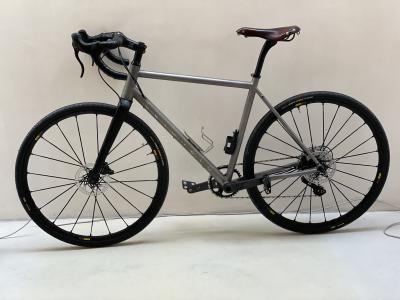
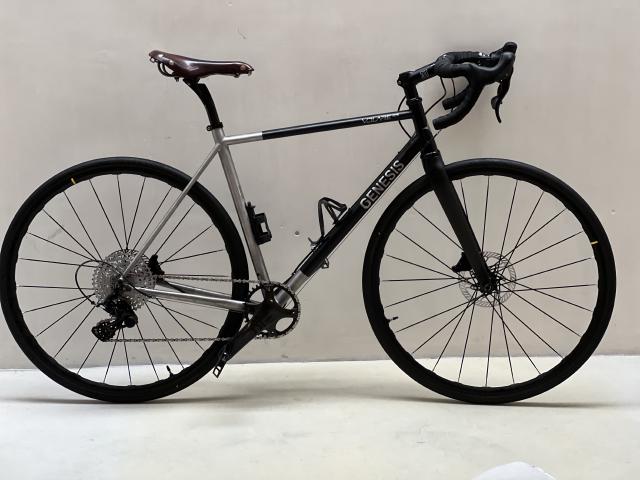
My Genesis Volare 931 Disc, built with these tubes from Birmingham, is perhaps the clearest technical statement in my entire collection. It says: we have solved the fundamental problem. Everything else is variation.
A Century of Drawing Tubes
Reynolds has been drawing steel tubes since 1898 — over 125 years of metallurgical refinement. Starting with basic butted tubes for aircraft and bicycles in the early twentieth century, they progressed through high-tensile steels, then to the chromoly alloys (520, 525, 531) that defined professional cycling for decades, then to increasingly exotic formulations that pushed what steel could achieve.
Each generation solved particular problems: weight, strength, resistance to fatigue, weldability, corrosion. The 531 tubes that built Merckx’s hour record bike were revelatory for their era. The 853 heat-treated chromoly that followed offered remarkable strength from thinner walls. But each generation also carried compromises — traditional chromoly steels, however refined, still corrode. Still require maintenance. Still age.
By the time Reynolds developed 931, they weren’t chasing marginal gains within the existing paradigm. They were engineering the endpoint of a certain kind of optimisation. 931 is a maraging stainless steel — a category of ultra-high-strength alloys developed originally for aerospace applications. The name comes from “martensitic ageing,” a heat treatment process that produces extraordinary hardness and strength. Reynolds adapted this metallurgy specifically for bicycle frames, meaning every characteristic was chosen with bicycle-specific requirements in mind.
The Numbers Behind the Poetry
The specification sheet for 931 reads like an argument won. Tensile strength of 1,200-1,500 MPa — comparable to the strongest titanium alloys and roughly double that of standard chromoly. This means thinner tube walls can be used while maintaining equivalent structural integrity, which directly translates to lighter frames. The Genesis Volare’s frame weighs 2.41 kilograms — remarkable for stainless steel, and competitive with many titanium and even some carbon frames of similar geometry.
But the number that matters most is zero: that’s the rate at which 931 corrodes under normal conditions. True stainless steel — not the marketing “stainless” of cheaper alloys that eventually spot and pit, but genuinely corrosion-proof at the molecular level. My Volare could sit uncoated in a British rainstorm for a decade and emerge unchanged. The silver finish isn’t a paint choice. It’s the material itself, presenting its own surface to the world.
Fewer than a handful of framebuilders are approved to work with 931. The material demands specific welding techniques and heat treatment protocols that Reynolds certifies on a builder-by-builder basis. This isn’t gatekeeping for its own sake — 931, improperly handled, loses the very properties that make it exceptional. The metallurgy requires precision not just in the alloy composition but in every subsequent fabrication step.
The Volare: A Case Study in Completeness
Genesis, the UK brand, worked closely with Reynolds to create the Volare 931 Disc — their flagship, no-holds-barred steel road bike. The collaboration between Birmingham’s tube-drawers and Genesis’s design team produced a frame with internal Di2 routing, a tapered headtube, 12mm thru-axles front and rear, and flat-mount disc brake tabs. These are emphatically modern features on a frame made from a material with a century of heritage behind it.
Mine runs Campagnolo Ekar 13-speed — the Italian gravel groupset, with its single chainring and wide-range cassette. The pairing seems incongruous on paper: British stainless steel, Italian gravel mechanicals, and a frame geometry designed for road speed. In practice, it’s one of the most versatile machines I own. The Ekar’s range covers everything from steep Swiss climbs to fast flats along the Rhine, while the 931 frame handles each scenario with the same composed efficiency.
The build details tell their own story. 3T Ergosum handlebars and Arx II stem — Swiss-Italian engineering for the contact points. Mavic Ksyrium UST Disc wheels with tubeless tyres, eliminating inner tubes and their associated weight and puncture risk. A Specialized S-Works Carbon CG-R seatpost — one of the few concessions to carbon in an otherwise metallic machine. And a Brooks leather saddle atop it all, because some traditions earn their continuation.
The complete bike is a contradiction that works: cutting-edge metallurgy supporting century-old saddle-making craft, connected by components from three countries and five manufacturers. Yet it rides as a coherent whole. The 931 frame is the unifying element — a material so confident in its own properties that it accommodates any component philosophy without protest.
The Ride Quality Question
There’s an argument in cycling circles about whether stainless steel rides differently from chromoly. Some riders claim it feels harsher, less lively — that the additional strength and hardness come at the cost of the gentle compliance that makes traditional steel feel so natural.
I haven’t found this to be true with 931. The Volare rides with a particular directness — feedback is clear, transmission of power is efficient — but I wouldn’t characterise it as harsh. What I think is happening is that 931’s specific stiffness characteristics create a ride quality that feels distinct from traditional steel. It’s not inferior; it’s differently efficient. The material has less of the slight flex-and-rebound quality of chromoly. Instead, it transmits more cleanly, with less energy absorption in the frame itself.
This directness, paired with the Mavic tubeless setup and the CG-R seatpost’s engineered compliance, produces a ride that is simultaneously more responsive and more comfortable than you’d expect from reading the spec sheet. The comfort comes from everywhere except the frame — which is perhaps the most elegant engineering solution of all.
The Maintenance Liberation
The single greatest practical advantage of 931 is the maintenance freedom it provides. I can leave the Volare in the rain. I can ride it through Swiss winter salt without developing rust. I can neglect the frame and still have a structure that won’t degrade.
This sounds trivial until you own multiple steel bikes and understand the accumulated maintenance burden. My Stelbel’s teal paint has nicks that need attention. The Mason Exposure’s metallic finish shows the marks of a bike that gets ridden hard in all conditions. Both frames require regular cleaning, occasional touch-up, and vigilance against corrosion at cable entry points and bottom bracket shells.
The 931 frame exists in a different maintenance category entirely. It asks nothing. It simply endures.
The Longevity Calculation
Reynolds 931 was engineered for indefinite durability. The stainless alloy resists fatigue in ways that mild steel cannot — the stress-cycle curves show a material that, within its design parameters, should not develop fatigue cracks over any reasonable timeframe. It doesn’t corrode. It doesn’t lose its temper with age.
Theoretically, a well-built 931 frame should last a human lifetime with minimal maintenance. The Volare, still relatively young, is beginning to verify this claim. The frame is entirely sound. No corrosion, no fatigue indicators, no structural degradation of any kind. The paint shows wear where the lock holder sat, but the underlying material is pristine. This is what engineering for endurance looks like — design decisions that assume the frame will outlast trends, outlast components, outlast the rider’s other bikes.
The Honest Aesthetic
Reynolds 931 is often finished with a brushed or raw stainless appearance, which some find beautiful and others find austere. The Volare’s silver finish reveals the tubing without heavy paint coverage. This is honest — you see exactly what the material is, how the tubes were joined, where the welds sit.
There’s something appealing about this transparency in an era of elaborate paint schemes designed to distract from what lies beneath. The 931 frame isn’t hiding behind carbon-weave graphics or gradient fades. It’s presenting itself straightforwardly: these are the tubes, this is how they’re constructed, this is what the material looks like. It’s not flashy, but it’s direct. And directness, in a bicycle, is usually the highest compliment.
The Endgame
Why Reynolds 931 represents the endgame isn’t because it’s the latest technology — it isn’t. It’s because it solved the fundamental problems of steel frame construction so thoroughly that meaningful improvement is marginal at best. You can make frames lighter with carbon fibre, faster with aerodynamic tube profiles, flashier with exotic paints.
But for a steel frame — traditional, honest, built to outlast its builder — Reynolds 931 represents the complete solution. The material does what it’s asked to do without compromise. It resists decay. It maintains its properties indefinitely. It rides well. And it asks nothing in return.
In my collection, the Genesis Volare stands as testimony to a material science approach that prioritised long-term excellence over marketing novelty. It’s not the lightest bike or the most romantic. But it might be the most thoughtfully engineered — a frame designed by people who understood that the best solution is one that requires no improvement.
Some engineering problems are solved incrementally, then incrementally, then incrementally again, forever approaching but never reaching perfection. Reynolds 931 is the rare case where the problem was simply solved.